RACE: Ferrari Bulls are in in control next target is 400 USD▪️ RACE / FERRARI — THE RECLAIM IS DONE. NEXT STOP IS THE 400 LIQUIDITY POOL. 🐎
▪️ Ferrari is pressing higher near 357, having already reclaimed its very-strong floor and turned it into a launch pad. Price is out of the base and climbing — this isn't a "will it hold" chart, it's a "how far does the run go" chart, and the answer sitting overhead is 400, where the biggest sell-side pool on the board rests.
▪️ Primary outlook: bullish continuation — reclaim confirmed, liquidity run in progress. The path of least resistance is up, with one intermediate wall to clear before the 400 target comes into range.
▪️ Key resistance zone: 376–384 — a ★★ 6.2/10 MODERATE wall leaned on 15 times, the one real speed bump between price and the target. Clear it and the lane to 400 opens.
▪️ Final target overhead: 400–408 — the Bear Liquidity Cluster (POWER 9/10, 13.81% depth), the "400 USD TP" for bulls. This is where trapped short liquidity and resting sell orders pool — in a bullish run, that cluster isn't resistance to fear, it's the magnet to aim at. Bulls hunt the sell-side.
▪️ Major defense line: 345–350 — a ★★★★ 8.1/10 VERY STRONG support at 10 retests, the freshly reclaimed floor and the line that keeps the bullish read alive. Lose it and the momentum thesis stalls.
▪️ Primary upside targets: clear 376–384 → 400 (Bear Cluster POWER 9/10).
▪️ Structural invalidation: a daily close back below 345 flips continuation into range, opening 329 → 305–313.
▪️ Bullish scenario (primary — yellow paths): hold above the reclaimed 345–350 floor → grind through the 376–384 moderate wall → drive into the 400–408 Bear Liquidity Cluster where the sell-side pool gets eaten. The staged run: floor → mid-wall → the pool. That's the 400 USD TP.
▪️ Bearish scenario (invalidation only): rejection before 376 and a loss of 345–350 → pullback into 329 (5.1 WEAK) and 305–313 (6.9 MODERATE). Deep invalidation is the 281–289 Bull Liquidity Cluster — the structural demand shelf that only comes into play if the whole reclaim unwinds.
▪️ KEY LEVELS
▪️ Current Price: ~357
RESISTANCES
▪️ 400–408 — Bear Liquidity Cluster · POWER 9/10 · 13.81% depth · final target / "400 USD TP BULLS" (sell-side pool)
▪️ 376–384 — ★★ 6.2/10 MODERATE · 15 retests · intermediate wall
SUPPORTS
▪️ 345–350 — ★★★★ 8.1/10 VERY STRONG · 10 retests · reclaimed floor / launch pad
▪️ 329 — ★ 5.1/10 WEAK · 5 retests
▪️ 305–313 — ★★ 6.9/10 MODERATE · 13 retests
▪️ 281–289 — Bull Liquidity Cluster · POWER 8/10 · 20.36% depth · deep demand magnet (structural)
▪️ 271–278 — ★★ 6.5/10 MODERATE · 12 retests
▪️ LIQUIDITY CLUSTER MAP
▪️ Overhead (sell-side pool): 400–408 — Bear Cluster POWER 9/10, 13.81% — the highest-value objective on the board and the target of this run. In an uptrend this is where price gets pulled: trapped shorts above 400 become fuel, and the resting sell orders are the liquidity bulls are driving toward. ~+12–13% from current.
▪️ Below (buy-side pool): 281–289 — Bull Cluster POWER 8/10, 20.36% — the deepest pool on the chart (biggest % depth) and the ultimate demand shelf. It's the catastrophe magnet, not an active level — only relevant if the reclaim fully fails. ~-20% from current.
▪️ The asymmetry: the active magnet is overhead (bear pool at 400), the safety-net magnet is far below (bull pool near 285). That's a bullish structure — the near-term pull is up.
🔍 THE SCENARIO PATH
▪️ Yellow legs (the run — primary): from 357, hold the 345–350 reclaimed floor → push through the 376–384 moderate wall (first checkpoint) → extend into the 400–408 Bear Liquidity Cluster (final TP). Two staged yellow arrows: the first clears the mid-wall, the second delivers into the pool. A multi-week traverse on the Daily, roughly +12% top to bottom of the move.
▪️ Invalidation leg (only if 345 breaks): step-down through 329 → 305–313, with the 281–289 Bull Cluster as the deep catch. Not the base case while the reclaim holds.
▪️ My read: The hard part already happened — reclaiming the 8.1 very-strong floor is what turns a bounce into a trend, and that's done. From here it's a liquidity run: the 400 Bear Cluster is a magnet, not a wall, because pools like that pull price in before they reverse. The high-value long is the continuation while 345–350 holds beneath; the 376–384 wall is the only friction between here and target. Structure stays bullish above 345 — that's the one number that matters. Lose it and this becomes a range again; hold it and 400 is the draw.
🔒 Levels and paths from the zone model. No signals, no repaint — a scenario, not a promise.
▪️ ProjectSyndicate Levels Desk — Overview of key S/R zones for XAUUSD, NVDA, NQ, ES & GC traders every week. Subscribe to stay up to date with the latest levels.
#RACE #Ferrari #Stocks #Trading
Ferrari NV
No trades
No trades
In-depth trading ideas
RACE | July Q3 2026 | Week ChartFerrari N.V. ||
MARKET-BEATING SCORE 4/10
Dividend yield (indicated)
1.11%
The only Ferrari I can afford... for now...
----------------------------------
RACE EPS growth 8.20% — modest growth, tracks rather than beats the market.
RACE revenue growing 4.65% YoY — steady but below high-growth threshold (15%+).
RACE gross margin 51.61% — strong moat, characteristic of long-run market beaters.
RACE FCF $1,621.00M positive — real cash generation, the #1 long-run predictor of market outperformance.
RACE D/E ratio 0.72 — conservative leverage, balance sheet resilience favors outperformance.
----------------------------------
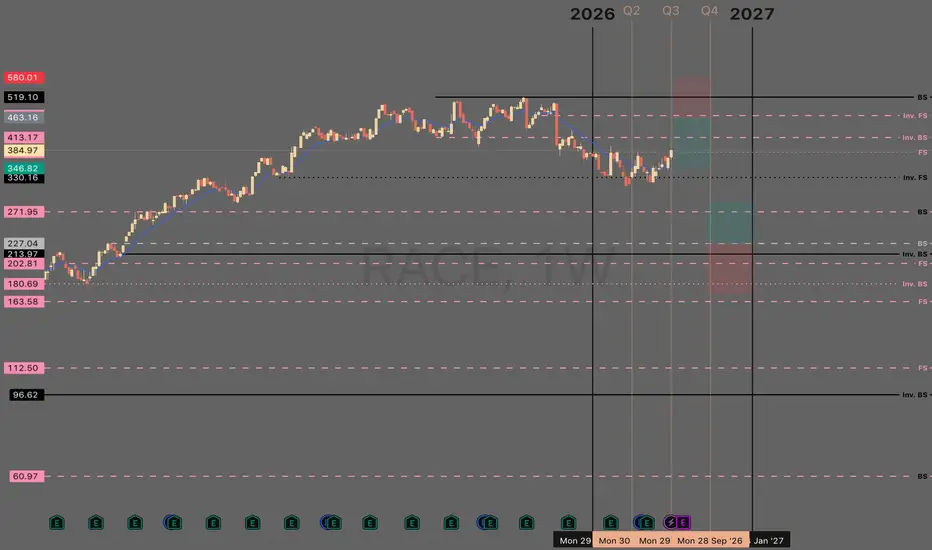
Multiple Time-Frame Analysis; Color Code | Strength favors the higher timeframe.
Yearly timeframe = black
Monthly timeframe = pink
weekly = grey
daily = red
4hr = orange
1hr = yellow
15min = blue
5min = green if they are shown. (Level visibility on intervals is set to timeframe the level was found on and below to keep chart view organized.)
** Candle Science explained **
A Range = two or more consecutive color candles.
There are two types of ranges - accumulation and distribution.
DISTRIBUTION RANGES DEFINED: BackSide (BS) Candle - First distribution candle in a distribution range. Expectation = strong reaction to price. long wicks reaching to or away from level.
FrontSide (FS) Candle - Last distribution candle in a distribution range. Expectation = reversal, create a trend in the opposite direction. Distribution candles are used as support.
ACCUMULATION RANGES DEFINED:
Inverse BS (Inv.BS) - First Accumulation candle in an accumulation range. Expectation. = strong reaction to price. long wicks reaching to or away from level.
Inverse FS (Inv.FS) - Last accumulation candle in an accumulation range. Expectation = reversal, create a trend in the opposite direction. Accumulation candles are used as resistance.
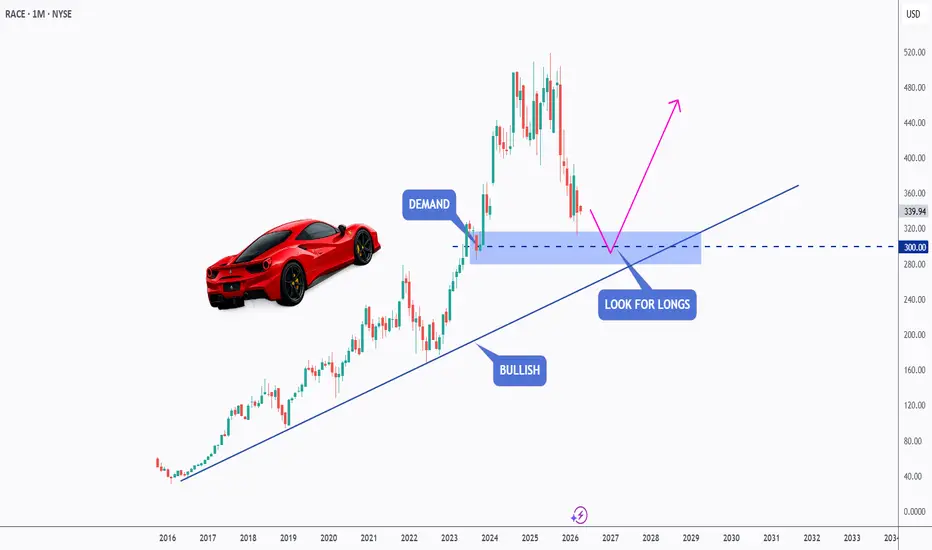
RACE: Luce Concerns Meet Major SupportOver the past week, Ferrari has been receiving a lot of criticism following the launch of its new EV model, the Luce.
Many investors quickly linked the recent decline in the stock price to the mixed reactions seen online, claiming the market was disappointed by the new EV model.
But is that really what's happening?
The Fundamental Side 📈
Despite the recent negativity, Ferrari continues to enjoy one of the strongest business models in the automotive industry.
Perhaps the most important fact is that Ferrari is reportedly fully booked with orders until late 2027.
That's not the profile of a company struggling with demand.
The TRIO Retest 🔑
From a technical standpoint, RACE is approaching what I call a TRIO Retest.
This is the intersection of three major bullish confluences:
1️⃣ The demand zone marked in red.
2️⃣ The long-term rising blue trendline.
3️⃣ The psychological $300 round number.
When multiple support factors align at the same level, they often create a stronger reaction zone than any individual support on its own.
Trading Outlook 📊
As long as this TRIO Retest holds, we will be looking for trend-following long opportunities.
The current correction may feel uncomfortable, but historically, Ferrari has shown that strong trends often go through deep pullbacks before continuing higher.
The market is currently focused on the Luce launch.
The chart is focused on structure.
And right now, structure suggests that Ferrari is approaching one of the most important support zones it has seen in years.
⚠️ Disclaimer: This is not financial advice. Always do your own research and manage risk properly.
📚 Stick to your trading plan regarding entries, risk, and management.
Good luck! 🍀
All Strategies Are Good; If Managed Properly!
~Richard Nasr
$RACE into precision manufacturing.Been seeing a lot of automakers making some interesting moves.
Base · fair value today
392
~6–7% revenue, margin stable-to-up; ~8% FCF growth; multiple holds ~28×
Bull · fair value today
665
+102% vs spot
Scarcity pricing persists + Elettrica success; ~11% FCF growth; re-rates to 38×.
other Catalysts,
*AI widens the wealth equality gap, more people driving the luxury brand name cars.
*Manufacturing in Robotics/Energy/electrical infrastructure - needs participation from major manufacturers.
*Engineering *many catalysts, we've seen names like RollsRoyce do similar.
Downsides? well there are many. this is not financial advise.
$RACE The Luce Sparked a Selloff. Ferrari DIPS Always Get BoughtFerrari unveiled the Luce, its first fully electric car, and the market sold the stock off hard. 📉 That reaction is not new.
Every time Ferrari has launched a controversial model or navigated a transitional period, the stock has pulled back and institutional buyers have stepped in. 🔄
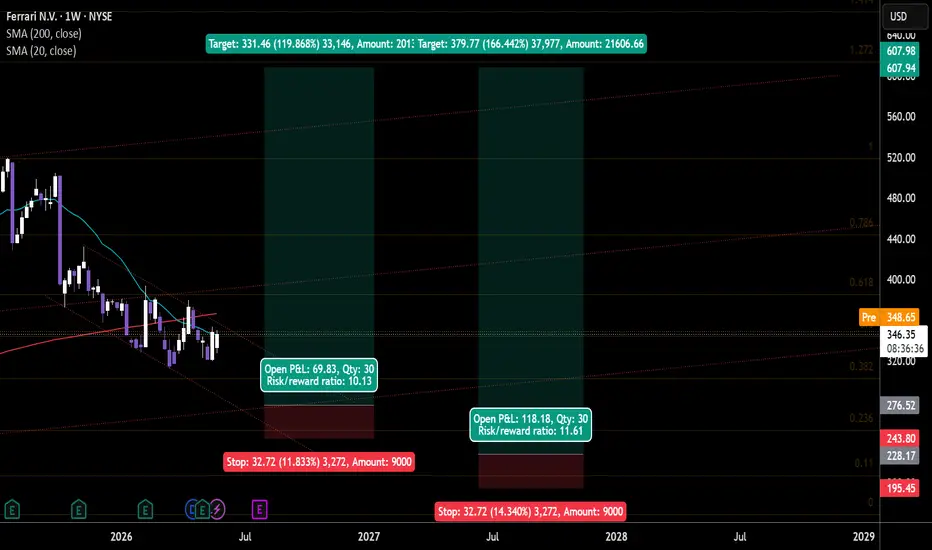
The weekly chart has now printed two clean demand zones. The dip is here. 📊
The fundamentals have not changed. 💪 Q1 2026 revenue came in at EUR 1.848 billion, up 3% year over year and up 6% at constant currency. 💰 EBITDA hit EUR 722 million with an EBITDA margin of 39.1%, up 4% year over year. 🤯
Operating profit margin reached 29.7%. Industrial free cash flow was EUR 653 million, up 5% year over year. Diluted EPS came in at EUR 2.33. ✅
CEO Benedetto Vigna confirmed 2026 guidance and stated the order book now extends towards the end of 2027. 📅 That is two full years of guaranteed revenue locked in. 🔒
The Luce is already receiving orders despite the criticism. 🚗 Ferrari CEO Vigna confirmed on 29 May 2026 that the Ferrari Luce is already getting orders, with the sense of anticipation described as the highest the company has ever seen ahead of a world premiere. 🔥
This is not a product failure. This is a market overreaction to change. ⚡
The buyback machine is running hard in the background. ♻️ Ferrari is executing a multi year share repurchase programme of approximately EUR 3.5 billion through 2030. The second tranche of EUR 250 million was launched in April 2026. 💵
27 analysts cover the stock with a median price target of $460.98 and a high target of $553.84. 11 Buy ratings and zero Sell ratings. 🐂 The 52 week range sits between $312.51 and $519.10. Next earnings are due 30 July 2026. 📅
The weekly chart has pulled back sharply from the 52 week high into two clean demand zones. ✅ Two entries. Two defined risk levels. One thesis. Ferrari dips get bought. 📊
🟢 Zone 1 (Upper Entry) ~ $276.52 area (0.236 Fibonacci Weekly)
💰 Entry: $276.52
🛑 Stop: $243.80 (11.833% below entry)
🎯 Target: $607.98 (119.9% upside from entry)
📈 Risk/Reward Ratio: 10.13
🟢 Zone 2 (Lower Entry) ~ $228.17 area (0.11 Fibonacci Weekly)
💰 Entry: $228.17
🛑 Stop: $195.45 (14.340% below entry)
🎯 Target: $607.94 (166.4% upside from entry)
📈 Risk/Reward Ratio: 11.61
📅 Next Earnings: 30 July 2026
♻️ Buyback Programme: EUR 3.5 billion through 2030
🔒 Order Book: Extends to end of 2027
🌍 52 Week Range: $312.51 to $519.10
The Luce sparked the selloff. 🚗 The order book is full through 2027. 🔒 Ferrari dips always get bought. Let price come to the zone and let the trade do the work. 🚀
⚠️ Not financial advice. Manage your risk.
Ferrari NV (RACE) Luca Cordero di Montezemolo on the new Ferrari Luce:
"If I said what I really think, I'd harm Ferrari. We're risking the destruction of a myth, I'm very sorry about that. I hope they at least remove the Prancing Horse from that car".
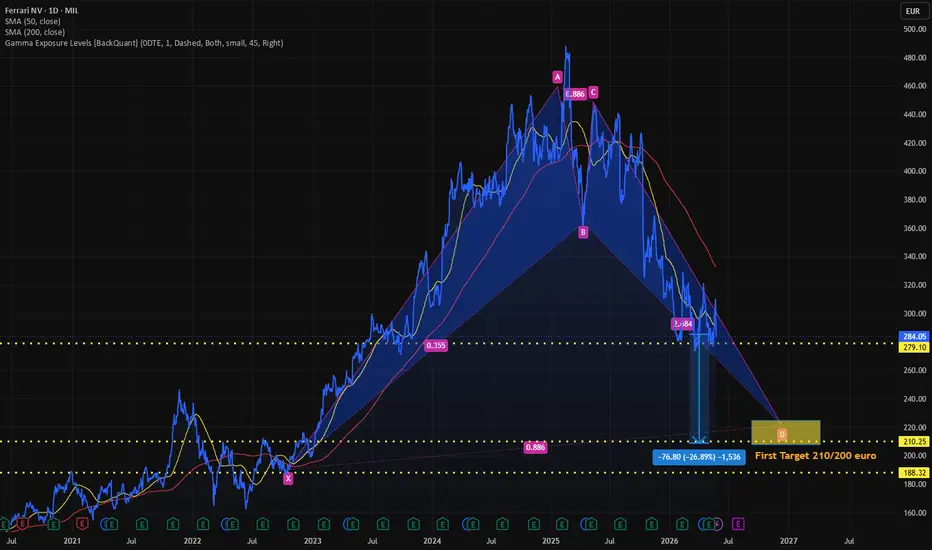
The new Ferrari Luce has been criticized worldwide, and there will certainly be consequences for the company and its profits. We believe the stock could fall further.
Please check here and send a message on X for complete analysis --> @CharlesRault
Ferrari (RACE): A Luxury Franchise Priced Like PerfectionExecutive Summary:
Ferrari is one of the rare industrial businesses that economically behaves more like a luxury brand. The company produces exceptional margins, strong free cash flow, and enjoys unusually clear demand visibility thanks to a multiyear order backlog. At the same time, Ferrari deliberately restricts production in order to maintain exclusivity.
The challenge for investors is that the stock already reflects a great deal of this success. Ferrari trades at valuation levels that effectively assume these economics will continue indefinitely. Margin of safety verdict: Ferrari appears to be a remarkable business, but the current price leaves little protection if margins normalize or electrification increases capital intensity.
One Stock, Dozens of Voices:
This is not the view of a single analyst. CrowdWisdom aggregated 29 independent sources for RACE (3 professional trader videos (YouTube); 20 financial research articles (web); 1 live market intelligence feeds; 4 prior CrowdWisdom analysis snapshots (internal archive); 1 verified financial data checks (Yahoo Finance)) and synthesized the common threads across them. The goal was to identify where traders, investors, and researchers broadly agree, where their views diverge, and what the market may be overlooking.
The conclusions were then stress tested by putting opposing views against each other: a bull case, a bear case that challenges the consensus, and a review of what expectations appear embedded in the current share price. All financial metrics were cross validated against live market data.
What follows highlights where opinion converges, where it splits, and whether the stock offers a meaningful margin of safety at today’s valuation.
Business Quality and Moat Durability:
Ferrari is best understood not as a typical automaker, but as a luxury brand that happens to manufacture automobiles.
Most car companies compete on scale, cost efficiency, and technological capability. Ferrari deliberately operates outside that model. Production is capped at roughly 13,600 vehicles per year. That constraint keeps demand consistently above supply and reinforces the aura surrounding the brand.
The financial results are extraordinary for a manufacturing business. In fiscal 2025 Ferrari generated about €7.1 billion in revenue and roughly €2.11 billion in operating profit. Operating margins around 29 to 30 percent are far above the automotive norm, where margins often fall below 10 percent.
Several forces reinforce Ferrari’s moat.
First is brand equity built over decades of racing success and cultural symbolism. Ferrari’s identity is deeply tied to Formula 1 and endurance racing, both of which function as powerful global marketing engines.
Second is controlled scarcity. By limiting supply, Ferrari preserves pricing power and resale value. Waiting lists are not a problem for the brand; they reinforce desirability.
Third is personalization. Custom options and special edition models significantly raise the average selling price and carry very high margins. Personalization revenue now represents a meaningful share of overall car revenue.
Fourth is the collector ecosystem. Limited edition Ferraris often appreciate in secondary markets, reinforcing the perception that ownership represents both status and a potential asset.
Moat durability assessment: stable.
The most significant structural threat comes from technological change. Ferrari’s emotional appeal has historically been tied to internal combustion engines and the mechanical driving experience. Electrification risks diluting that identity if handled poorly. If Ferrari successfully translates its brand into the electric performance era, however, the moat could remain intact.
Return on Invested Capital (ROIC):
Precise ROIC figures are not available in the verified dataset, which limits exact measurement. Even so, Ferrari’s operating profile strongly implies historically high returns on capital.
A company generating nearly €2.1 billion in operating profit on €7.1 billion of revenue while operating at limited production scale is clearly extracting substantial value from intangible assets rather than heavy physical capital.
Industrial free cash flow reached about €1.54 billion in 2025, equivalent to roughly a 21 percent free cash flow margin. That level of cash generation suggests returns on invested capital well above the automotive sector average.
Historically Ferrari’s capital intensity was moderate. The company did not require massive factory expansion because growth was driven more by pricing and product mix than by volume.
Looking forward, the picture becomes less certain.
Electrification introduces a different capital structure. Electric vehicles require meaningful investment in battery integration, software capabilities, and updated manufacturing infrastructure. Ferrari has already constructed new facilities to support this shift and expects capital expenditures to rise modestly in the coming years.
If the capital required per vehicle increases substantially, future ROIC could decline even if revenue continues to grow.
The central question is whether Ferrari’s pricing power can offset a larger capital base. If the company can command a substantial premium for electric performance vehicles, incremental returns may remain attractive.
Quality of Earnings:
Ferrari’s reported earnings appear well supported by real cash generation.
Industrial free cash flow of about €1.538 billion in 2025 exceeded net income levels, which generally signals strong earnings quality. Unlike many capital intensive manufacturers, Ferrari converts a large share of its profits into cash.
Several structural factors help explain this.
First, the company largely builds vehicles against confirmed orders, reducing inventory risk and stabilizing working capital.
Second, Ferrari’s very high average selling prices allow development costs to be spread across premium margins.
Third, personalization and special editions add incremental profit with relatively modest additional capital requirements.
The main potential pressure point for cash conversion is rising capital expenditure tied to electrification and ongoing research and development.
For now, the relationship between earnings and free cash flow appears solid.
Capital Allocation Scorecard:
Ferrari’s capital allocation has generally been disciplined and shareholder friendly.
In 2025 the company completed about €2 billion in share buybacks and returned more than €1.3 billion to shareholders through dividends and repurchases combined. The dividend for the year was €2.50 per share.
These distributions occurred while maintaining a relatively conservative balance sheet. Net debt stood around €1.44 billion and leverage remains modest relative to operating profit.
Management has also continued to invest heavily in product development, racing programs, and brand building. Participation in Formula 1 in particular functions as a marketing platform that reinforces Ferrari’s premium positioning.
Capital allocation grade: strong.
The one potential concern relates to valuation discipline. Repurchasing shares at elevated earnings multiples may not create long term value if growth slows.
Customer and Revenue Concentration:
Ferrari does not face customer concentration in the traditional sense of relying on a few large buyers. Instead, the concentration risk lies in the type of customer it serves.
The company sells primarily to ultra high net worth individuals. With global production of roughly 13,600 cars per year, Ferrari ultimately depends on a relatively small pool of wealthy buyers.
Many of these customers are repeat buyers and collectors, which builds loyalty but also introduces sensitivity to broader economic conditions.
Luxury spending among the ultra wealthy often tracks asset prices such as equities, real estate, and private business valuations. A global downturn in asset values could reduce demand for high end discretionary purchases.
Ferrari’s order book currently extends into late 2027 and represents roughly €5 billion in confirmed orders, giving the company strong near term visibility. Even so, luxury demand has historically been cyclical.
Management Alignment:
Ferrari’s ownership structure reflects its history within the broader Exor industrial group.
Exor remains the largest shareholder and has historically emphasized long term brand preservation over short term volume growth. Ferrari’s deliberate decision to limit production suggests management incentives align with protecting the brand’s long term value.
Company leadership also consistently emphasizes product excellence and exclusivity rather than maximizing quarterly deliveries. This orientation is consistent with a luxury brand mindset rather than a traditional industrial growth model.
10-Year Durability Test:
For long term investors, the key question is whether the Ferrari of 2036 will resemble the Ferrari of today.
Several structural forces could reshape the business over the next decade.
The most obvious is electrification. Governments in Europe and elsewhere continue tightening emissions regulations, gradually pushing manufacturers away from internal combustion engines. Ferrari will need to launch electric models that maintain performance prestige without undermining the emotional appeal of the brand.
A second risk is technological commoditization. Electric drivetrains deliver instant acceleration even in relatively inexpensive vehicles. If performance advantages narrow across the industry, Ferrari will need to lean more heavily on design, exclusivity, and brand heritage.
Third is brand dilution risk. Expanding production too aggressively or introducing too many models could weaken the scarcity that supports Ferrari’s pricing power.
Fourth is luxury demand cyclicality. Ferrari’s customer base is small and closely tied to global wealth creation.
Despite these uncertainties, Ferrari’s brand equity remains unusually durable. Few automotive brands carry the same cultural resonance, and the competitive landscape in ultra luxury performance cars has remained relatively stable for decades.
Predicting the exact technological configuration of Ferrari’s vehicles ten years from now is difficult. Predicting that wealthy collectors will still want Ferraris is much easier.
Multi-Year Thesis (3 to 7 years):
Base Case (Probability 50 percent)
Assumptions:
Revenue grows roughly 6 to 8 percent annually through pricing power, personalization, and selective model expansion.
Operating margins remain near 28 to 30 percent.
Free cash flow grows broadly in line with revenue despite rising electrification investment.
Estimated intrinsic value: approximately $380 to $420 per share.
Bull Case (Probability 25 percent)
Assumptions:
Electric Ferrari models successfully extend the brand into the EV era without eroding demand.
Personalization and limited edition vehicles increase revenue per car significantly.
Margins expand slightly above 30 percent and free cash flow compounds strongly.
Estimated intrinsic value: roughly $450 to $520 per share.
Bear Case (Probability 25 percent)
Assumptions:
Electrification increases capital intensity and reduces incremental returns on invested capital.
Margins compress toward 20 to 22 percent as costs rise.
Luxury demand weakens due to macroeconomic conditions.
Estimated intrinsic value: approximately $200 to $260 per share.
Probability weighted intrinsic value clusters roughly around the high $300 range per share.
Margin of Safety Verdict:
Ferrari shares recently trade around the mid $300 range with trailing earnings multiples above 30 times and enterprise value to EBITDA multiples above 25 times.
Intrinsic value estimates across models vary widely, ranging from roughly $200 in conservative scenarios to over $450 in optimistic ones. Even under favorable assumptions, the implied margin of safety rarely exceeds about 15 to 20 percent.
Traditional value investors generally require at least a 20 to 30 percent discount to intrinsic value before committing capital.
By that standard, Ferrari does not currently offer a sufficient margin of safety.
As a result, this analysis becomes more of an intellectual exercise in evaluating a remarkable business than a clear buy recommendation.
Peak Margin Stress Test:
Ferrari currently operates with EBIT margins near 29.5 percent.
For context, most premium automakers operate with margins between roughly 10 and 15 percent. Even successful luxury auto manufacturers rarely approach Ferrari’s level of profitability.
If Ferrari’s operating margin fell from roughly 29.5 percent to about 22 percent while revenue remained constant, operating profit would decline by roughly 25 to 30 percent.
If the market simultaneously re rated the stock from about 33 times earnings to something closer to 22 to 25 times earnings, the implied equity value could fall 40 to 50 percent despite the business remaining profitable.
This illustrates how much of Ferrari’s valuation depends on sustaining unusually high margins over time.
Valuation Framing:
Ferrari’s valuation reflects its hybrid identity as both a luxury brand and an industrial manufacturer.
Compared with automakers, Ferrari appears extremely expensive. Global auto companies often trade between 10 and 20 times earnings.
Compared with luxury goods companies, Ferrari appears somewhat less extreme. Luxury brands with strong pricing power sometimes command multiples above 30 times earnings.
The market is effectively valuing Ferrari as a luxury franchise rather than a conventional automaker.
For meaningful upside to materialize, several assumptions must hold simultaneously.
Ferrari must maintain operating margins close to current levels.
Electrification must not weaken pricing power.
Demand from ultra wealthy customers must remain resilient.
If any of these assumptions deteriorate, valuation compression becomes likely.
Perception vs Reality:
Perception: Ferrari is a premium automaker benefiting from strong luxury demand.
Reality: Ferrari behaves economically like a luxury brand that happens to produce automobiles.
At the same time, the market may be overly confident about the permanence of these economics. Manufacturing businesses rarely sustain operating margins near 30 percent indefinitely.
Why This May Be Misunderstood:
Many investors compare Ferrari with traditional automakers and conclude the stock deserves a premium multiple.
That comparison is reasonable but incomplete.
Ferrari’s true peer group may be closer to luxury houses like Hermès or LVMH. Those companies benefit from similar pricing power but operate in industries with far lower technological disruption risk.
Ferrari must preserve its brand while simultaneously navigating a significant technological transition in electrification.
Three Measurable Things to Watch Next Quarter:
Order backlog depth and cancellation trends.
Personalization revenue growth and average selling price per vehicle.
Capital expenditure trajectory related to electrification investment.
Historical Conviction Drift:
Investor conviction in Ferrari has remained relatively strong over the past decade as the company consistently delivered high margins and robust cash flow.
Sentiment has still moved with valuation cycles. As multiples expanded and later contracted, the stock experienced periods of enthusiasm followed by pullbacks.
Over longer horizons Ferrari shares have generated strong multi year returns, but shorter stretches have included meaningful declines when growth expectations moderated.
This pattern is common among high quality companies that trade at premium valuations.
Disconfirming Evidence:
The strongest argument against owning Ferrari centers on valuation combined with structural uncertainty.
The market already prices the company as though its current economic advantages will persist for decades. Any combination of margin compression, electrification challenges, or weakening luxury demand could trigger a significant re rating.
In addition, Ferrari’s production cap inherently limits volume growth. Revenue expansion must come primarily from pricing power and product mix rather than large increases in output.
Risks:
Electrification risk if Ferrari fails to maintain brand differentiation in electric vehicles.
Luxury demand cyclicality tied to global asset prices and wealth creation.
Margin compression from rising research and development or manufacturing costs.
Brand dilution if production limits are relaxed.
Currency fluctuations affecting profitability due to global sales exposure.
Summary:
Ferrari remains one of the most extraordinary franchises in global manufacturing.
Its mix of brand prestige, disciplined supply control, and pricing power produces margins and free cash flow rarely seen in the automotive industry.
But investment success depends not only on business quality. Price matters.
At current valuation levels Ferrari appears priced for near perfect execution. Investors buying today are effectively assuming the company maintains peak margins, successfully transitions into the electrified era, and continues compounding free cash flow at attractive rates.
Those outcomes are possible. The issue is that the current price leaves very little room for error.
Data Snapshot:
Ticker: RACE
Metric: Value
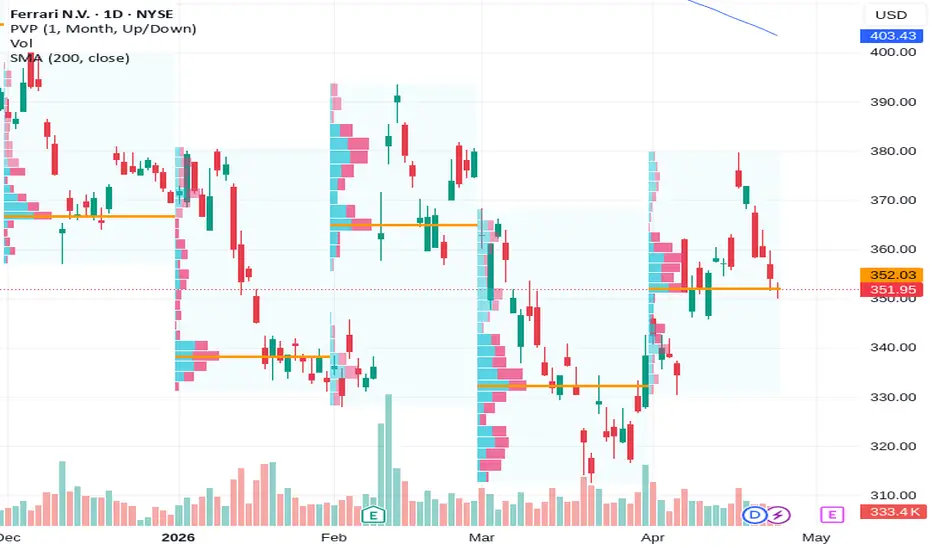
Current Price (RACE): $351.95
Market Capitalization: $62.99 billion
Shares Outstanding: 176,462,002
Trailing P/E: 33.46x
Forward P/E: 27.96x
Enterprise Value (EV): $64.27 billion
EV/EBITDA: 26.70x
Revenue (TTM): $7.15 billion
Gross Margin: 51.68%
Operating Margin: 28.62%
Free Cash Flow (FCF): $839.14 million
FCF Yield: 1.33%
52-Week Range: $312.51 to $519.10
Sector: Consumer Cyclical
Industry: Auto Manufacturers
References:
This analysis reviewed approximately 776 article sources and 80 video transcripts.
1. Yahoo Finance. Ferrari N.V. (RACE): A Bull Case Theory. finance.yahoo.com
2. Yahoo Finance. Ferrari N.V. (RACE): A Bull Case Theory. finance.yahoo.com
3. Yahoo Finance. Ferrari (RACE) Valuation Check As Long Term Returns Contrast With Recent Share Price Pullback. finance.yahoo.com
4. Yahoo Finance. Is Ferrari N.V. (RACE) A Good Stock To Buy Now?. finance.yahoo.com
5. Yahoo Finance. Ferrari N.V. (RACE): A Bull Case Theory. finance.yahoo.com
6. Yahoo Finance. Ferrari (NYSE:RACE) Valuation Check After Mixed Returns And Rich P/E Multiples. finance.yahoo.com
7. Yahoo Finance. Should Ferrari’s Volume Cap and New Credit Facility Reshape Its Long Term Story for Investors?. finance.yahoo.com
8. Yahoo Finance. Ferrari (NYSE:RACE) Valuation Check After Recent Pullback And Conflicting Fair Value Signals. finance.yahoo.com
9. Yahoo Finance. Is Ferrari N.V. (NYSE:RACE) Potentially Undervalued?. finance.yahoo.com
10. Quartr. Ferrari N.V. Company Financial Overview. quartr.com
11. Seeking Alpha. Ferrari Balance Sheet Overview. seekingalpha.com
12. YouTube Channel markets. Luxury sector commentary. www.youtube.com
13. YouTube Channel OscarRamos. Ferrari market analysis. www.youtube.com
14. YouTube Channel OneOption. Market commentary referencing Ferrari. www.youtube.com
Disclaimer:
This analysis is for informational and educational purposes only and does not constitute investment advice. Investors should conduct their own research and consider their financial situation before making investment decisions.
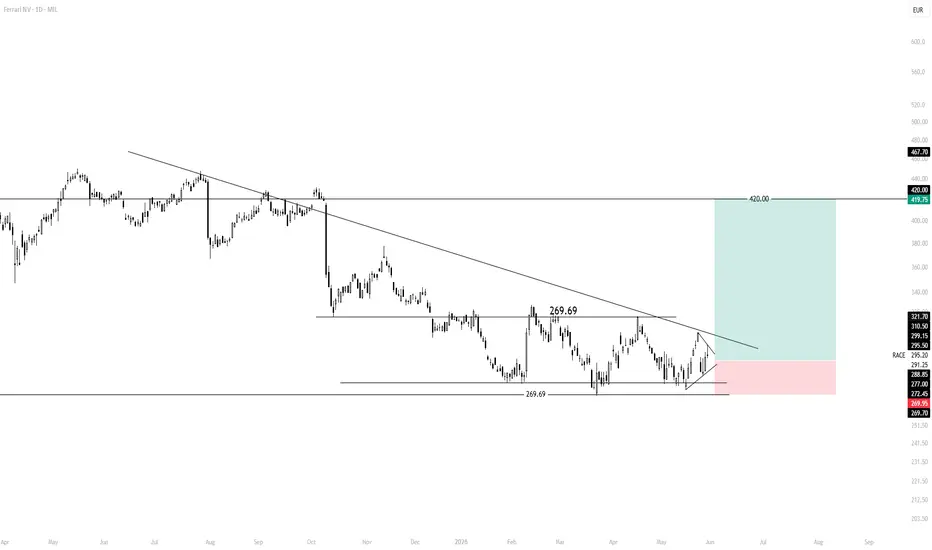
Ferrari - Ready for the Next Ride?RACE has been in a correction phase lately,
but price is now approaching a very strong support zone.
This area is not random.
It’s the intersection of:
• Rising trendline
• 300 round number
• Demand zone
A clear confluence.
As long as this zone holds,
the bulls remain in control.
And we will be looking for trend-following longs
targeting a continuation toward higher levels.
Lose this level…
and the structure starts to weaken.
But for now, the setup is clear.
Do you think Ferrari is just refueling here…
or is the engine starting to stall?
⚠️ Disclaimer: This is not financial advice. Always do your own research and manage risk properly.
📚 Stick to your trading plan regarding entries, risk, and management.
Good luck! 🍀
All Strategies Are Good; If Managed Properly!
~Richard Nasr
RACEFERRARI ( NYSE:RACE ): A Buying Opportunity or an Investor Trap?
Shares of the Italian legend slumped following the October Capital Markets Day, as the market was disappointed by a modest growth forecast.
During this key investor event, Ferrari made two major announcements that triggered the correction:
Conservative 2030 Targets: The company set a revenue target of approximately €9 billion. This implies a compound annual growth rate (CAGR) of only ~5%—significantly lower than in previous years.
EV Strategy Shift: The projected share of all-electric models by 2030 was halved, from 40% to 20%. The focus has shifted toward "horizontal diversification," emphasizing more limited-edition models.
The market perceived this as a slowdown in the growth story.
However, management emphasizes that growth will not be driven by volume, but by a richer product mix, personalization, and price increases.
What the market may have underestimated:
Despite the conservative forecasts, the company continues to demonstrate phenomenal operational efficiency.
Ahead of Schedule: At Investor Day, Ferrari raised its guidance, announcing it would hit its 2026 profitability targets a year early (in 2025).
Shareholder Returns: A €2 billion share buyback program (3.34% of market cap) has been completed, and a new €3.5 billion buyback program for 2026–2030 has been approved.
Dividends: The payout ratio increased from 35% to 40% of adjusted net profit.
Strong Demand: The order book is full until 2027. Scarcity and anticipation remains a core pillar of the brand’s value.
Key Figures:
🔎
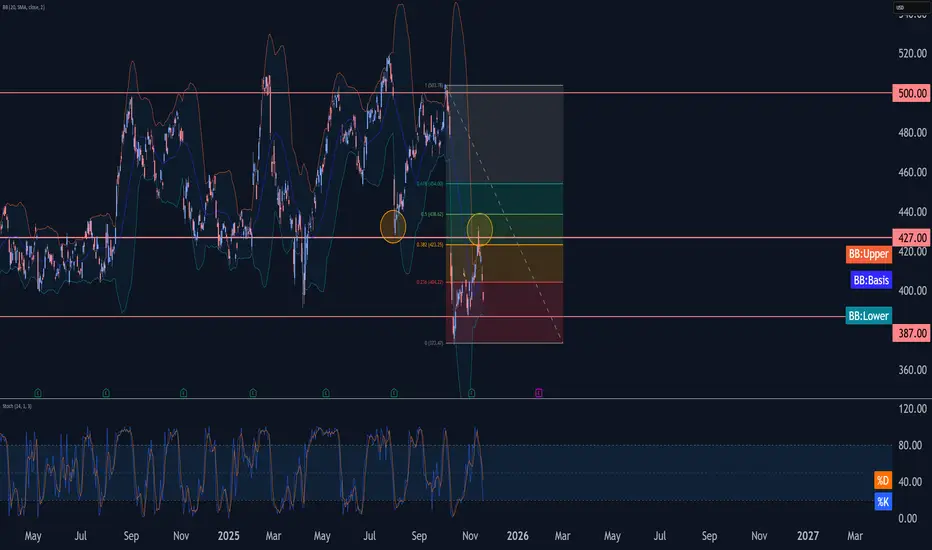
Ferrari Wave Analysis – 18 November 2025
- Ferrari reversed from resistance zone
- Likely to fall to support level 387.00
Ferrari recently reversed down from the resistance zone between the resistance level 427.00 (former monthly low from August), upper daily Bollinger Band and the 38.2% Fibonacci correction of the downward impulse c from October.
The downward reversal from this resistance zone started the active short-term correction ii.
Ferrari can be expected to fall further to the next support level 387.00 (former low of wave b from the end of October).
Ferrari RACE Technicals Led Entry With 100% Upside in 2026
RACE is in a measured correction after its July 2025 ATH (~$517). A repeat of prior ~35% corrections (2018/19; 2022) implies a symmetry target near ~$336 (35% off $516), creating a high-quality “buy the pullback” setup for smart investors willing to scale in before fundamentals re-assert. With the current price around ~$400, a full 35% retrace would complete near the low-$330s; prior cycles then delivered outsized recoveries. We view the $330–$360 zone as a strategic accumulation area for 100%+ multi-year upside potential, with a 2026 bull target >$700 assuming backlog support, margin resilience, and successful new product execution. ATH/price data cross-checked from market sources.
________________________________________
Executive Summary
• Thesis: Ferrari remains the purest “luxury-automotive as luxury-goods” equity: scarce supply, sold-out order book into 2026, rising personalization, and a carefully staged electrification roadmap supported by the new Maranello e-building. Even with macro or tariff noise, Ferrari’s brand, pricing power, and capital discipline underpin premium multiples.
• Why now: The stock’s technical correction is doing the valuation work for you. Into weakness, we favor staged entries ahead of 2026 catalysts EV debut & deliveries; new model cadence; ongoing buybacks.
• Key risks we underwrite: macro wealth shocks; execution on first BEV; regulatory/tariff volatility; FX EUR/USD; and luxury demand rotation. Offsetting: backlog visibility, personalization mix, and buybacks.
________________________________________
Ferrari (RACE) Catalyst Scorecard and 2026 Outlook
1) 🏎 New Model Launches & Portfolio — 9/10
Fresh models e.g., Roma Spider, 296 family, 12Cilindri plus track-focused/limited series sustain mix and ASPs. Purosangue remains capacity-constrained by design ≤~20% of shipments, supporting scarcity. Notes: media and management have repeatedly referenced Purosangue caps and order pauses. Rumor watch: the market expects additional halo launches into 2026; specifics beyond official IR should be treated as provisional.
2) 🔌 EV & Hybrid Transition — 9/10
Ferrari’s e-building went live in 2024 to manufacture ICE, hybrid, and the first BEV, enabling in-house e-axles/battery work and flexible capacity. Management reiterated an EV unveiling in October 2025 with sales beginning 2026; external reporting often cites incremental capacity of ~6,000 units management hasn’t fixed a public number. Strategy: electrify without diluting brand character.
3) 💰 Pricing Power & Personalization — 9/10
Personalizations are a structurally expanding, high-margin revenue stream—running ~~20% of revenues by 2025 commentary—while ultra-limited models e.g., Daytona SP3, 499P Modificata add mix tailwinds. Ferrari consistently emphasizes “quality of revenues over volume.”
4) 🌍 Global Demand & Wealth Resilience — 8/10
Order visibility remains exceptional, with management and financial press citing books effectively filled into 2026 even amid tariffs and China softness; U.S./EU/Middle East wealth pools anchor demand. Hybrids already approach half of deliveries, de-risking compliance.
5) 📈 Order Backlog & Supply Discipline — 8/10
Production is deliberately capped; Purosangue constrained to protect exclusivity. Backlog sold-out deep into 2026 reduces cyclicality and protects margins through mix and scarcity.
6) 💵 Shareholder Returns & Capital Allocation — 7.5/10
Ferrari is methodically executing a multi-year €2bn buyback through 2026 alongside dividends, while maintaining heavy R&D and capex for electrification and new platforms. Recent IR updates confirm ongoing tranches.
7) ⚖ Tariffs & Trade — 7/10
The 2025 U.S.–EU deal reduced tariff pressure versus prior peaks, a modest tailwind to margins and pricing optics for EU autos; Ferrari has shown ability to pass costs to clientele.
8) 🏆 Brand & Competitive Moat — 9/10
Ferrari’s moat resembles top luxury houses more than automakers: waiting lists, repeat/collector buyers, F1 halo, and unrivaled pricing power. This underpins luxury-goods-like multiples and high returns. (Multiple third-party and IR references.)
9) ⚔ Competition & Luxury Peers — 6/10
Peers Lamborghini, McLaren, Rimac, etc. lack Ferrari’s breadth/brand equity. Luxury EV entrants pose incremental risk, but Ferrari’s pacing plus customer loyalty mitigate. General industry assessment; monitor EV launches from peers.
10) 📉 Macro & Economic Cycle — 6/10
Ferrari isn’t immune to wealth drawdowns; however, backlog and personalization provide buffers. Management has historically protected price/mix by flexing volumes if needed.
________________________________________
2026 Outlook What Must Go Right
• EV milestone: Successful first-BEV launch & deliveries with waitlists experience parity with hybrids; no brand dilution.
• Mix strength: Purosangue/12Cilindri/hyper/limited series maintain ASPs and margins; personalization share inches higher.
• Financial delivery: Hitting or beating upgraded plan markers into 2026 after Ferrari indicated it is tracking ahead on profitability versus the original 2026 targets.
• Capital returns: Continued cadence on the €2bn buyback; dividend growth within FCF discipline.
________________________________________
Valuation Snapshot
• Quality context: Ferrari’s 2024 print and IR commentary emphasize expanding mix/personalization and ahead-of-plan profitability into 2025/26. Refer to FY24 results + CMD updates.
• Peer framing: Treat RACE as luxury Hermès-like scarcity rather than auto OEM. This justifies premium EV/EBITDA and P/E vs mass OEMs, provided growth/margins hold.
• Multiple work: On pullbacks to the mid-$300s, implied 2026E EV/EBITDA compresses to attractive territory vs luxury comps assuming consensus-style growth/margins investors should plug house estimates.
________________________________________
Scenarios & Targets
• Bull ($700–$750) — Successful BEV introduction, backlog conversion, personalization >20% of sales, steady buybacks, and benign macro.
• Base ($580–$620) — Order book carries revenues; margins hold with disciplined volumes; EV ramps without profit drag.
• Bear ($350–$400) — Wealth shock or EV stumble; cancellations rise, mix weakens; tariff/FX pressure re-rates the multiple. Risk case consistent with technical $330s correction.
________________________________________
Entry & Risk Management Plan
• Where to buy: Scale in $360–$380; add aggressively $330–$360 35% measured-move zone.
• Sizing: For a diversified HNWI book, a core 1.5–3.0% NAV position, with room to add +100–150 bps on capitulation into the $330s.
• Stops/hedges: Soft stop on a decisive weekly break <$320; hedge via short auto-luxury basket or long USD if EUR strength risks translation.
• Time horizon: 18–30 months through 2026 catalysts.
________________________________________
Near-Term Catalyst Timetable rolling 12–18 months
• Oct 2025–1H 2026: First Ferrari BEV unveil → initial deliveries watch order intake, waitlist depth, option take-rate, margin commentary.
• Ongoing 2025–26: Buyback tranches; monitor IR posts for pace/size.
• Quarterlies/Capital Markets updates 2025–26: Mix/personalization trajectory; backlog commentary; Purosangue allocation discipline.
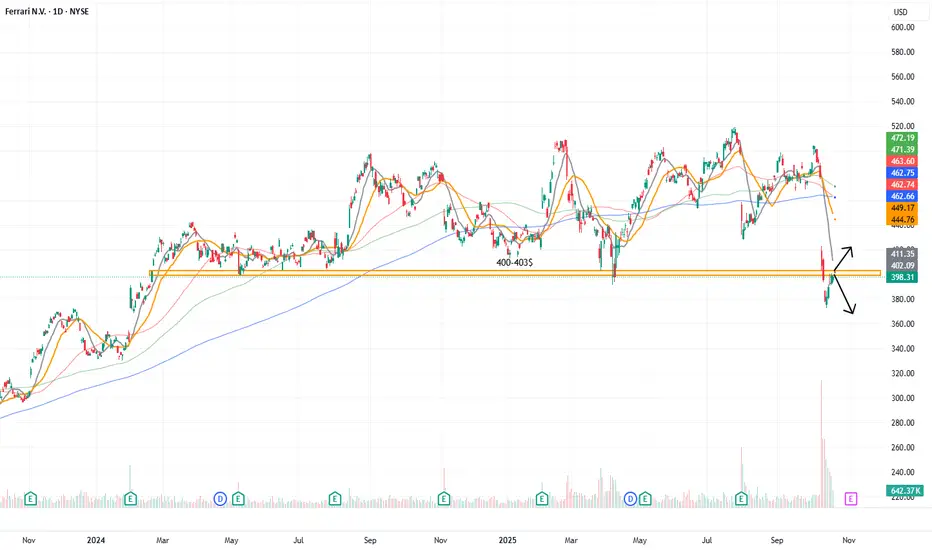
Ready to make a moveThe price has been fluctuating for the third consecutive day below the orange resistance level shown in the chart ($400–403).
A decisive direction is likely to emerge soon, and it should be supported by increasing volume.
If a breakout to the upside occurs, it could be an opportunity to increase exposure or enter partially.
Conversely, if the price decisively reverses downward, it's better to reduce positions and wait for the next lows.
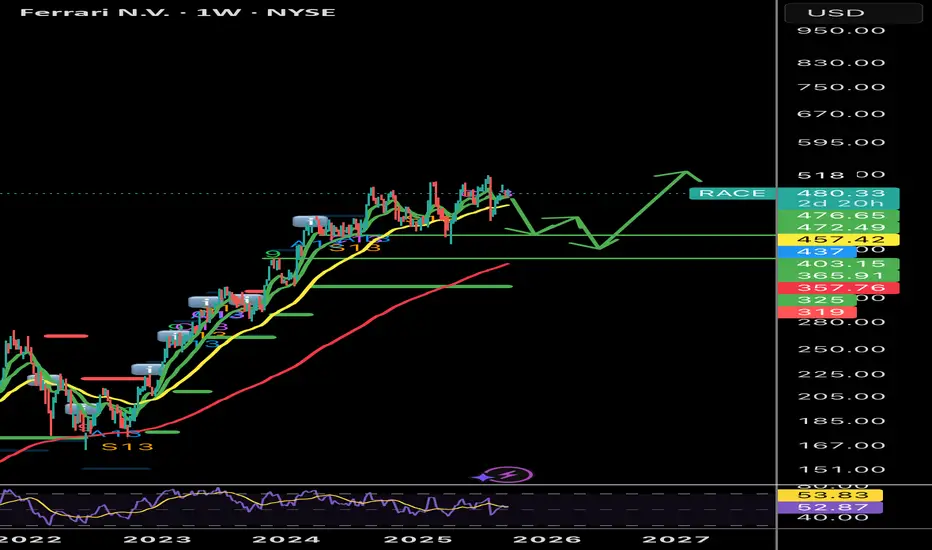
Gap down and go?This could just keep grinding higher, but I think an opportunity could be coming. This has been trading in a distribution pattern, I believe there are some weak hands that need to be shaken out. I’m looking for a correction into the zone outlined. I’ll be playing this with some long dated options / commons. This won’t be active until zone is hit.
Race to the Bottom or Top?Ferrari first and foremost is an automaker, but one like no other. It is the ultimate luxury brand, producing margins more like Hermes than Ford. With 30% plus operating margins and over 20% ROIC. There's no questioning the moat, brand heritage and scarcity, that creates a long term defensible moat and compounding story.
That being said, the stock got way ahead of itself. If you pay attention to my Minds post, I signalled this stock had topped out and was a race to the bottom. This was when I opened a swing short as we lost the 200 day moving average at $460. I have taken profits and we are now sitting at $378.
Why did I close my short? I don't often short the best brands in the world, but the valuation was getting out of hand. Now we are sitting in line with historical valuations, currently the P/E sits at 36 and forward P/E of 34.
My TA suggests we are close to a level of support at the 200 week EMA around $364. That will also complete the gap fill. The question for me is whether or not we are in a Wave 4 move heading to one last push to the upside. Or if we are in Wave B of an ABC correction. The chart suggests the latter, with a possible flush down to $307. So I remain on the sidelines for now, with a bearish bias. I have given bulls a potential price target to start accumulating a position for a longer term hold.
Not financial advice, just free TA, follow for my trades. I will be watching this one closely and will keep the idea frequently updated.
RACE Wave Analysis – 10 October 2025
- RACE approaching multi-month support level 389.80
- Likely to fall to support level 375.00
RACE has been falling sharply over the last few trading sessions after the price failed to break above the round resistance level 500.00 (which has been reversing the price from January).
The price is currently approaching the strong multi-month support level 389.80 (which reversed the price in April).
If the price breaks below the support level 389.80 - RACE can be expected to fall to the next support level 375.00.
Ferrari (RACE) Catalyst Scorecard AND 2026 OutlookFerrari (RACE) Catalyst Scorecard AND 2026 Outlook
________________________________________
1. 🏎 New Model Launches & Portfolio (9/10)
Ferrari’s 2023–26 lineup is packed with high-end launches. Recent additions include the Roma Spider, SF90 XX, 296 Challenge, and 499P Modificata. Demand for the Purosangue SUV has been overwhelming, with early orders suspended and deliveries backlogged into 2026. Coming next: the 849 Testarossa plug-in hybrid deliveries H2 2025/Q1 2026 and the F80 hybrid hypercar limited series, ~1,200 hp. These models should sustain ASP growth and keep exclusivity intact.
________________________________________
2. 🔌 EV & Hybrid Transition (9/10)
Ferrari is phasing electrification deliberately. After hybrids like the SF90 and 296, Ferrari will unveil its first fully electric car in October 2025 deliveries start 2026. A new “e-building” in Maranello is ready to expand capacity by ~6,000 units annually. Ferrari is building in-house motors and batteries while still pledging to keep V12 ICE alive as long as possible. This balance between heritage and compliance ensures both regulatory cover and customer enthusiasm.
________________________________________
3. 💰 Pricing Power & Personalization (9/10)
Ferrari’s bespoke strategy fuels unmatched pricing power. Recent results showed hundreds of millions in incremental profit from high-priced halo models Daytona SP3, 499P Modificata and personalization demand. Personalization now represents nearly one-fifth of revenues. Carefully managed price hikes on core models, combined with ultra-limited editions, cement Ferrari’s position as the most profitable automaker per unit.
________________________________________
4. 🌍 Global Demand & Wealth Resilience (8/10)
About three-quarters of Ferrari’s sales go to repeat customers, and nearly half to collectors owning multiple Ferraris. The expanding global wealthy class adds to the demand pool. Ferrari’s sales are well balanced across regions; China is only ~10%, limiting exposure to that slowdown. Wealth concentration in the U.S., Europe, and the Middle East provides resilience against macro shocks.
________________________________________
5. 📈 Order Backlog & Supply Discipline (8/10)
Ferrari’s order book is sold out through 2026/early 2027. The company deliberately caps production e.g. Purosangue SUV shipments limited to ~20% of total to preserve scarcity. This ensures pricing discipline and supports margin expansion. With supply tightly managed, Ferrari avoids the discounting and inventory overhangs that plague mass-market automakers.
________________________________________
6. 💵 Shareholder Returns & Capital Allocation (7.5/10)
Ferrari’s capital return story is strong. Annual dividends and share buybacks together exceed €750 million. The €2 billion buyback program through 2026 is ongoing. At the same time, Ferrari invests aggressively in R&D e-building, hybrid/EV systems without margin erosion. The balance between shareholder distributions and future growth spending is a key investor confidence driver.
________________________________________
7. ⚖ U.S./EU Tariffs & Trade (7/10)
A recent U.S.–EU deal cut auto tariffs, enabling Ferrari to avoid planned price hikes in the U.S. and improving margins slightly. Regulatory pressure on emissions is real, but Ferrari’s measured EV roadmap addresses compliance. Trade risks are less critical for Ferrari than for volume automakers, but favorable deals add incremental margin upside.
________________________________________
8. 🏆 Brand & Competitive Moat (9/10)
Ferrari’s brand power is unmatched. It combines scarcity, desirability, and F1 heritage to justify luxury-goods multiples more in line with Hermès than Porsche. The brand enables Ferrari to command unmatched ASPs and maintain margins north of 25%. Ferrari’s intangible moat protects it against both cyclical demand dips and competitive threats.
________________________________________
9. ⚔ Competition & Luxury Peers (6/10)
Direct competitors—Lamborghini, McLaren, Rimac—lack Ferrari’s scale, heritage, and breadth. Luxury EV entrants pose some risk, but Ferrari’s controlled rollout and customer loyalty limit the threat. Peer comparisons place Ferrari firmly alongside high-end luxury brands, not mass-market automakers, underscoring its unique positioning.
________________________________________
10. 📉 Macro & Economic Cycle (6/10)
Ferrari is somewhat insulated but not immune. A sharp global downturn or wealth destruction could dampen orders. However, its backlog, exclusivity, and personalization revenue provide cushions. Even in recessions, Ferrari can slow production and still maintain pricing power.
________________________________________
Catalyst Scorecard
Rank Catalyst Score
1 New Model Launches & Portfolio 9.0
2 EV & Hybrid Strategy 9.0
3 Pricing Power & Personalization 9.0
4 Brand & Competitive Moat 9.0
5 Global Demand & Wealth Trends 8.0
6 Order Book & Supply Discipline 8.0
7 Shareholder Returns 7.5
8 U.S./EU Tariffs & Trade 7.0
9 Competition & Luxury Peers 6.0
10 Macro & Economic Cycle 6.0
________________________________________
Valuation Scenarios
• Bull Case ($700–$750): Successful EV debut, robust demand for new models, strong margins, continued buybacks.
• Base Case ($580–$620): Order backlog supports steady revenue growth, modest EV contribution, pricing discipline.
• Bear Case ($350–$400): Macro downturn or execution missteps lead to cancellations and lower margins.
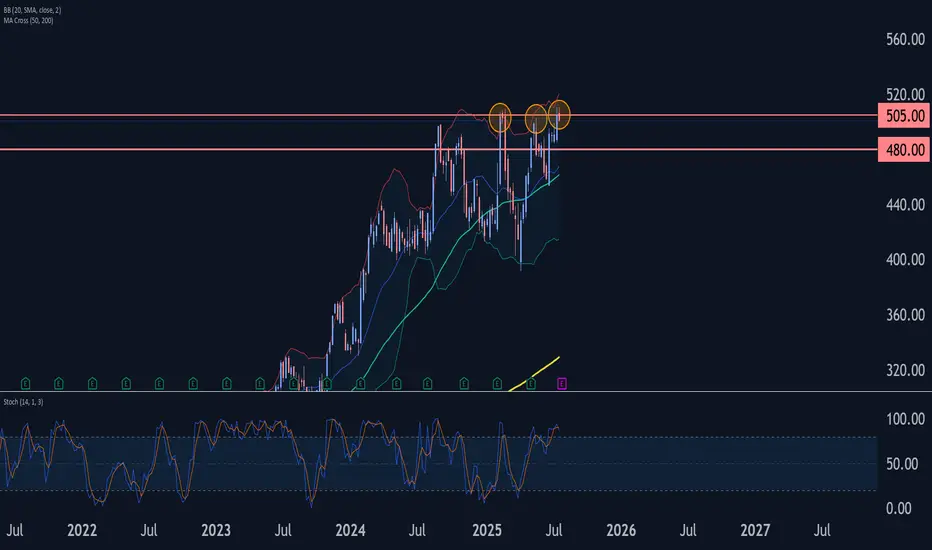
Race Wave Analysis – 22 July 2025
- Race reversed from long-term resistance level 505.00
- Likely to fall to support level 480.00
Race recently reversed down from the strong long-term resistance level 505.00, which has been reversing the price from the start of 2025, as can be seen below.
The resistance level 505.00 was strengthened by the upper daily and weekly Bollinger Bands.
Given the strength of the resistance level 505.00 and the overbought weekly Stochastic, Race can be expected to fall to the next support level 480.00.
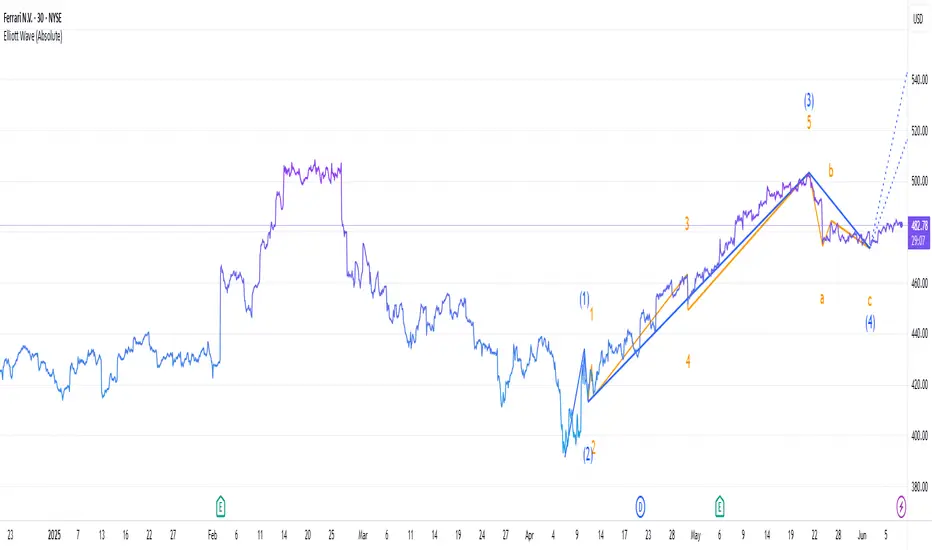
Is Ferrari's stock still bullish?Is Ferrari's stock still bullish?
Technical Outlook
Elliot Wave theory suggests a cautious bullish stance. The present correction seems to be a temporary setback, likely driven by guidance and tariff fears, but sets the stage for a potential rally to $520-$540 if support is not broken. However, risks of a deeper correction (i.e., to $420-$440) persist if pressures from the outside intensify.
The stock is currently trading above all three of its major EMA levels — daily, weekly, and monthly — that is a good technical signal. The rising daily EMA at 479.98 suggests that short-run momentum remains healthy. The weekly EMA at 461.77 provides medium-term support, while the monthly EMA at 421.08 supports the longer-term trend solidly.
Positive Sentiment Factors
Ferrari reported robust Q1 2025 results, with net revenues of €1.79 billion (up 13% YoY), an operating profit of €542 million (up 22.7%), and a net profit of €412 million (up 17%). Adjusted earnings per share were €2.30, surpassing analyst expectations of €2.28. This shows Ferrari’s strong pricing power and demand for personalized vehicles.
Analyst Sentiment: Optimism remains for Ferrari among some analysts. UBS raised its price target to $560 from $520, maintaining a Buy rating, with the new Ferrari Elettrica a major catalyst, the company said. Bernstein and RBC Capital maintained Outperform ratings on the stock at $575 and €500, respectively. Barclays upgraded Ferrari to Overweight, calling it a "safe haven" in a shaky European automotive environment.
Brand Strength and Strategic Positioning: Ferrari’s luxury brand and high demand for models like the Roma Spider, 296 GTS, SF90 XX, and Purosangue bolster its market position.
Neutral Sentiment Factors
Market and Industry Context: The broader market has been volatile due to trade developments and tariff relief rallies. Ferrari’s stock has been influenced by these macroeconomic factors, but its luxury positioning makes it less sensitive than mass-market automakers.
Formula 1 Performance: Ferrari’s underwhelming Formula 1 season, with McLaren significantly outscoring Ferrari in points poses some concern among investors. While this does not directly impact stock performance, it may indirectly affect brand sentiment among enthusiasts.
Negative Sentiment Factors
Tariff Concerns: Ferrari shares have been sensitive to Trump's U.S. tariff policies. A tariff increase would add up to $50,000 to the price of an average Ferrari, potentially cutting sales volumes in the U.S., which accounts for 28.8% of net sales. JPMorgan warned that tariff impacts might be "worse" for Ferrari, lowering the price target to $460 from $525
Conclusion
Ferrari stock has a bullish but cautious bias, supported by solid fundamentals, favorable technical momentum, and positive analyst sentiment on upcoming product releases such as the Ferrari Elettrica. Macro risks, however, including U.S. trade policy and market volatility, are still major overhangs.
RACE Wave Analysis – 22 May 2025- RACE reversed from round resistance level 500.00
- Likely to fall to support level 460.00
RACE earlier reversed from the strong resistance area between the major round resistance level 500.00 (which has been reversing the price from the middle of 2024) and the upper weekly Bollinger Band.
The last time the price reversed down from the resistance level 500.00 it formed the weekly Japanese candlesticks reversal Evening Star – signalling the strength of this resistance level.
Given the overbought reading on the weekly Stochastic indicator, RACE can be expected to fall to the next support level 460.00.